Note: Names of organizations, offices, departments, etc. in the article are as of when the article was first published.
Inspired by his older brother, Hiroyuki Takasaki started playing soccer when he was in second grade.
He simply loved the game and wanted to get better. So he practiced—and kept practicing.
Years of hard work eventually took him to Japan’s professional J.League, where he built a career as a striker, playing for clubs including Urawa Red Diamonds, Kashima Antlers, and Matsumoto Yamaga FC.
And then came an entirely different challenge.
After retiring from professional soccer, Mr. Takasaki chose a new field for his second career: agriculture.
| Date | March 17, 2026 |
|---|---|
| Place | Shinshu Farm Land |
| Model in Use | TR72wb |
A Career in Professional Soccer—and a Home in Matsumoto
―― When you were a child, was it your dream to become a professional soccer player?
Mr. Takasaki
Not really. The J.League hadn’t even started yet when I began playing. I just genuinely loved soccer. That love turned into a desire to get better and play at a higher level, and eventually I became a professional.
―― But surely enjoying the game alone wasn’t enough to get you there?
Mr. Takasaki
I was never a genius or an exceptionally skilled player, so I had no choice but to practice incredibly hard. I practiced shooting more than anyone else.
―― You went on to score many goals as a striker and set records with the teams you played for.
Mr. Takasaki
Before I became a professional, I practiced shooting every morning and evening. A regular training session was about two hours, but I would practice in the morning and then stay after team training to practice on my own. I’m tall, so I also spent a lot of time practicing headers.
I scored a lot of goals, but I missed many more shots than I scored. If you don’t shoot, you’ll never miss, but you’ll never score either. So I just kept practicing.
―― Did you also have a particularly good instinct for finding scoring opportunities?
Mr. Takasaki
I don’t know about that. I couldn’t score by myself. Soccer is a team sport, and there’s a whole process before the ball reaches me. Those goals weren’t mine alone. I was able to score because the other players helped me, and I’m very grateful for that.
―― It sounds like the people around you played an important part in your career.
From 2016 to 2019, Mr. Takasaki played for Matsumoto Yamaga FC, based in Matsumoto, Nagano Prefecture—the same city where T&D’s Matsumoto Base is located. During his time with the club, he decided to build a home there.
―― Why did you decide to make Matsumoto your home?
Mr. Takasaki
It’s not too urban and not too rural, and everything is fairly compact. The people around me were also really kind. I gradually started thinking, “I could live here. I’d like to live here.”

A Second Career in Agriculture
―― Had you already been thinking about going into agriculture while you were still playing?
Mr. Takasaki
No. My retirement came suddenly, and I honestly had no idea what I was going to do next. Then someone asked if I’d be interested in growing white oyster mushrooms. I went with my gut and said yes the very next day.
But once I actually started thinking about it, I was worried about relying on mushrooms alone. That was what led me to try other types of farming as well.
Today, Mr. Takasaki grows white oyster mushrooms, Japanese mountain yams, and watermelons in Yamagata Village, Nagano Prefecture.
―― You have people you call your mentors, right?
Mr. Takasaki
I have a mushroom mentor and a farming mentor. My farming mentor is still a Matsumoto Yamaga supporter and buys a season pass every year. They taught me everything from scratch—or really, from zero.
―― So that connection also came through Matsumoto Yamaga. It seems that, here too, you’ve been fortunate to have people around you who have supported you.
Mr. Takasaki
Yes. I’m independent now, but they still teach me a lot and point out things I need to improve.
How T&D Data Loggers Became Part of the Farm
―― White oyster mushrooms seem to be a relatively unusual variety. Are there many other farms growing them commercially in Japan?
Mr. Takasaki
There may be other people growing them, but I haven’t heard of another farmer making a business out of them. So that’s something I feel confident about, and I think it gives us a distinctive strength.
―― Are they more difficult to grow than other types of mushrooms?
Mr. Takasaki
Actually, they’re relatively easy to grow. The fungus is quite robust, so they grow well.
―― What led you to start using T&D data loggers?
Mr. Takasaki
This is my fifth year growing white oyster mushrooms. During the first two summers, it was so hot that we lost all of the mushrooms.
During the mushroom cultivation process, the temperature should normally be kept at around 26–28°C (79–82°F). But we didn’t have air conditioning at the time, and the temperature rose to nearly 40°C (104°F). The mushroom cultures couldn’t survive the heat, and some of the hotels we supplied ended their contracts with us.
It happened two summers in a row. We received support through crowdfunding and were able to install four air-conditioning units. That was also when we decided we needed to properly monitor temperature and humidity, so we introduced T&D data loggers.

What Changed After Monitoring Began
Mr. Takasaki
We had been checking the temperature with a mercury thermometer, but we had no way of knowing the humidity. Once we started monitoring it, we could really see how much the humidity changed.
It was difficult to tell just by feel how dry the room actually was, so being able to see it in numbers made a big difference.
We had been spraying water on the floor to maintain humidity. Immediately afterward, the humidity would be ideal for growing mushrooms, but by the time we came back the next morning, the room would already be extremely dry.
―― Humidity seems to be particularly important for growing mushrooms.
Mr. Takasaki
Especially in winter, it was so dry that I thought there was no way we could grow mushrooms at that humidity. So we bought humidifiers as well.
Being able to see the temperature and humidity as numbers all the time meant we could actually take action.
―― So all of that helped stabilize the growing environment.
Mr. Takasaki
Yes. I also went back again and again to the hotels that had stopped buying from us and asked them to give us another chance. Starting last year, we were able to do business with them again. In that sense, the changes we made really helped us.
Using Data Loggers Across the Farm
Mr. Takasaki checks the temperature and humidity readings from his T&D data logger in the mushroom growing room every morning and evening.
But mushrooms are not the only crop for which environmental data matters.
He also uses data loggers in the greenhouse where Japanese mountain yams are stored. In winter, temperatures can fall below freezing, which can damage the yams, so he monitors the temperature to prevent them from freezing.
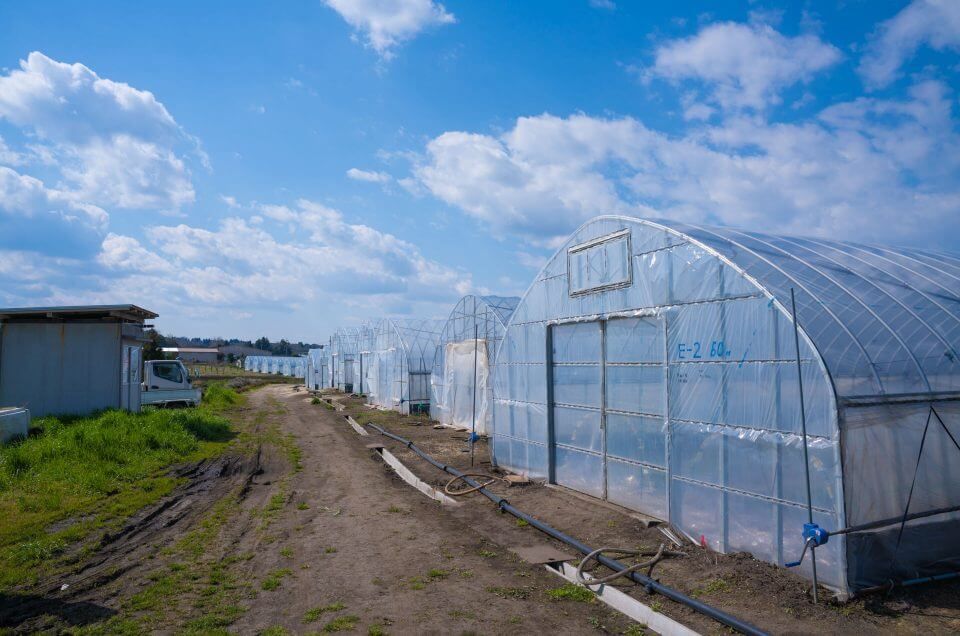
For his watermelons, he uses data loggers in the low tunnels starting in April. The temperature readings help him decide when to open or close the tunnels.
Low tunnels are small, temporary greenhouse-like structures made by stretching plastic sheeting over curved supports. They protect young plants from frost, rain, and wind in the cooler months of early spring, while retaining heat to encourage growth.

“The Great Revival”
In 2024, Mr. Takasaki achieved one of his goals by incorporating his farming business as TGR.
―― What does the name TGR mean?
Mr. Takasaki
My personal motto is “gashin shotan.” Inspired by that idea, I came up with the phrase “THE GREAT REVIVAL,” and that’s where the initials TGR come from.
It means enduring difficult times, using them as motivation, and continuing to move forward.
Gashin shotan (臥薪嘗胆) is a historical idiom about enduring hardship and continuing to work toward a goal until it is achieved.
―― What would you like to challenge yourself with next? Do you have any other dreams or goals?
Mr. Takasaki
Right now, my priority is to make the farming business stable. Once it reaches the point where I can entrust more of it to other people, I’d like to take on something new again.
You only get one life, so I want to keep challenging myself in different ways.
―― Farming can be physically demanding, can’t it?
Mr. Takasaki
I’m confident in my strength and stamina!
―― Do professional soccer and farming have anything in common?
Mr. Takasaki
I think it’s about continuing to put in the work and preparing properly.
As a soccer player, you have to train properly so you can perform well in a match. Farming is similar. If you do the work properly during the preparation stage, you can produce something good. That part feels very similar to me.
―― Would you recommend farming as a second career for soccer players?
Mr. Takasaki
I think agriculture could be a good career for athletes in general, especially if they start learning the know-how while they’re still young. I’d like to see more athletes consider farming.
I want to produce solid results myself and become an example that shows professional soccer players that agriculture can be a viable second career.

Those words brought to mind the striker who once thrilled supporters in the stands and inspired young soccer players who dreamed of following in his footsteps.
Mr. Takasaki has always had dreams and goals—and has never been afraid of the hard work and perseverance needed to pursue them. In that sense, the spirit of “gashin shotan” has been there all along.
The field may have changed, but the mindset of the striker remains: prepare carefully, keep putting in the work, and never stop taking on new challenges.
Perhaps that is what his “THE GREAT REVIVAL” is really about.